Most UK service firms that say they have “done AI” have installed a better search box. They pay for ChatGPT or Claude, a few people use it to draft emails and summarise documents, and that is where it stops. The Office for National Statistics has the numbers: around 35% of UK businesses with ten or more staff now use AI, but the average adopter runs just 1.6 different AI technologies, barely up from 1.4 in late 2023. Adoption is wide and shallow. The return on investment is somewhere else entirely.
What firms actually bought
The ONS breakdown for June 2026 is revealing. Large language models sit at 18% of businesses, visual content creation at 16%, machine-learning data processing at 12%, robotics at 2%. “Improving business operations” is the most common stated purpose, at roughly 60% of AI users. Yet only 11% of firms have given more than half their workforce any AI training, and 41% say they face no barriers to adoption at all.
Read those last two together. The tool is on the desk, almost nobody was taught to build anything with it, and most firms do not believe anything is stopping them. They simply have not done the work. And the work being skipped is process automation: not a chatbot that answers a question, but a system that takes a recurring, multi-step job and runs it from start to finish, with a person checking the part that carries risk.
Where the return actually is
People who build these systems for a living are blunt about it. The money is in deterministic, rule-based workflows, and you do not need a model for most of it. One automation practitioner writing on Substack lays out three tiers, and the order matters:
- Deterministic workflows. Predictable, rule-based, no model involved. A form submission creates the project, sets up the folder, sends the kickoff email and books the calendar invite.
- AI-enhanced workflows. The model handles one small judgement inside an otherwise fixed process. It reads an enquiry and picks which template applies, or turns messy call notes into a standard summary. This covers roughly half of real tasks.
- Autonomous agents. Genuinely open-ended, and genuinely unpredictable. Only worth attempting once the first two tiers are solid.
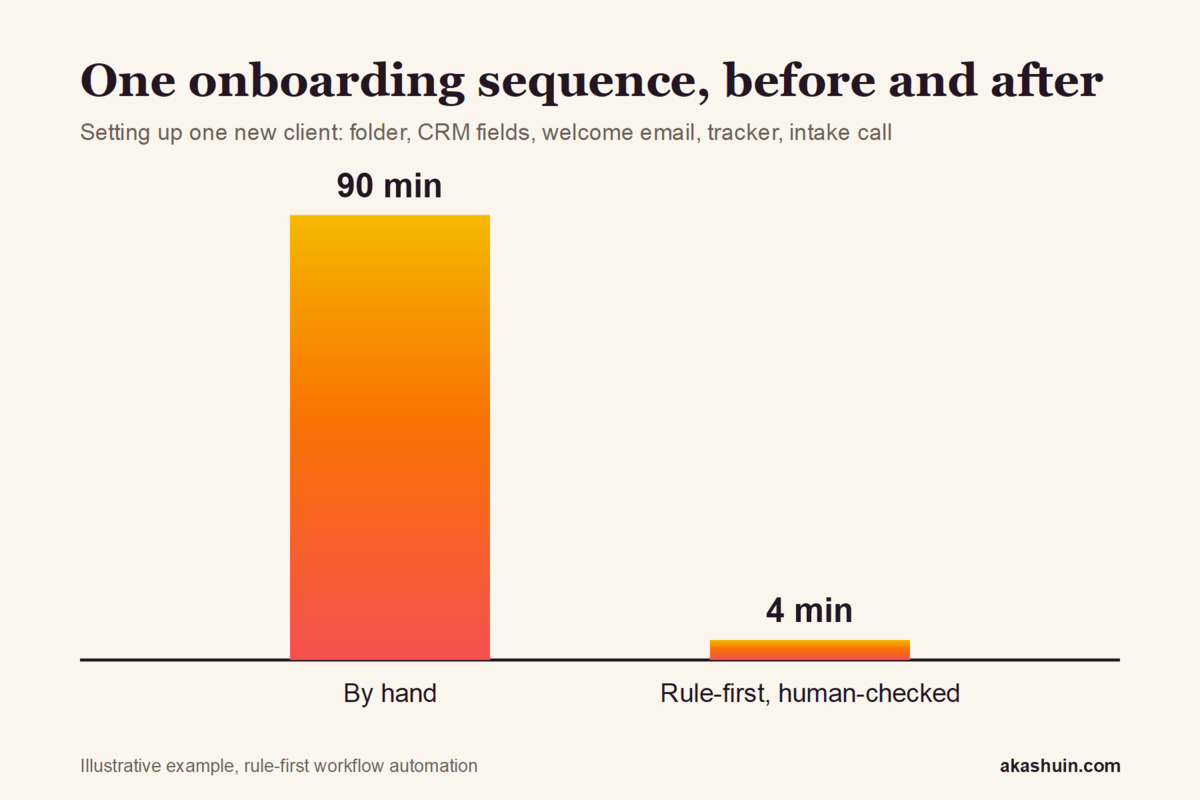
A concrete version. A recruitment firm signs a new client, and someone spends an hour and a half creating the folder structure, copying the contract details into the CRM, drafting the welcome email, setting up the shared tracker and scheduling the intake call. Every field in that sequence has a fixed source. None of it needs a model. Built as a plain workflow triggered by the signed contract, the same sequence takes about four minutes of review, and the person who used to do it gets that ninety minutes back every time.
Rule-based automation of this kind returns 30% to 200% in the first year, according to that same analysis. The reason it works is unglamorous. It removes hours of copy-paste admin that a person was doing every week, and those hours have a known cost.
A chatbot answers a question. A rule finishes a job.
Why the boring version gets skipped
Autonomous agents are the interesting part, so that is where people start. They hit the unpredictability, watch it break on something a rule would have handled, and conclude automation is not ready yet. As that practitioner puts it: “They start at the top, hit the unpredictability, and conclude automation doesn’t work.”
Meanwhile the client, or your own team, never wanted an agent. They wanted the client onboarding sequence to stop eating ninety minutes every time someone signs. They wanted the monthly report to assemble itself. Ruben Hassid, who writes the How to AI newsletter for a large non-technical audience, frames the same idea as spotting the repeated pattern, naming the context it needs, and turning it into a reusable checklist. Start there, not with the moonshot.
Try this
Four steps, in order, that you can start this week.
- Run the two-of-four test. Take a task and check it against four criteria: repetitive, time-consuming, error-prone, scalable. If it meets at least two, it is a candidate for automation. If it meets none, leave it alone. This stops you automating things that were never the problem.
- Count the hours before you build anything. Time the task honestly across a normal week, then multiply by the hourly cost of whoever does it. That single number is both your business case and your measure of success. The goal is “fifteen hours recovered this month”, not “we deployed AI”.
- Build rule-first. Map every step. Automate the ones with a fixed answer using plain tooling: Zapier, Make, a short Google Apps Script, or the workflow builder already inside your CRM. Only bring a model in where a step genuinely needs judgement, such as classifying an inbound message or compressing notes into a set format.
- Keep a person on the risky step. Anything that sends an external email, moves money, or changes a client record should pause for human approval before it fires. That approval gate is what makes the whole thing safe to switch on and leave running.
Working out which of your recurring workflows are worth automating, and in what order, is most of the effort. It is also exactly what our process automation service produces if you would rather not run the exercise in-house: a shortlist of processes ranked by hours saved, then the builds that clear them.
The point
If you run a UK service firm and you have “done AI” this year, ask one question. Have you automated a single process from end to end, or have you just handed people a smarter search box? The first compounds quietly every month. The second is a subscription. The firms pulling ahead are not the ones with the cleverest agents. They are the ones who found the ninety-minute job that happens every week and turned it into a five-minute job.
Sources: ONS, Artificial intelligence in UK businesses, 2023 to 2026; “You’re building agents. They wanted a rule.”, Substack; How to AI by Ruben Hassid.
Leave a Reply