Substack told its writers this year that it will start demoting and removing “AI slop” from its recommendation engine. No warning shot, no grace period. If a post reads like generic filler with no point of view behind it, the algorithm now buries it, even when a human technically wrote it. That’s the moment content marketing changed, and most agencies haven’t clocked it yet.
The gap nobody’s talking about
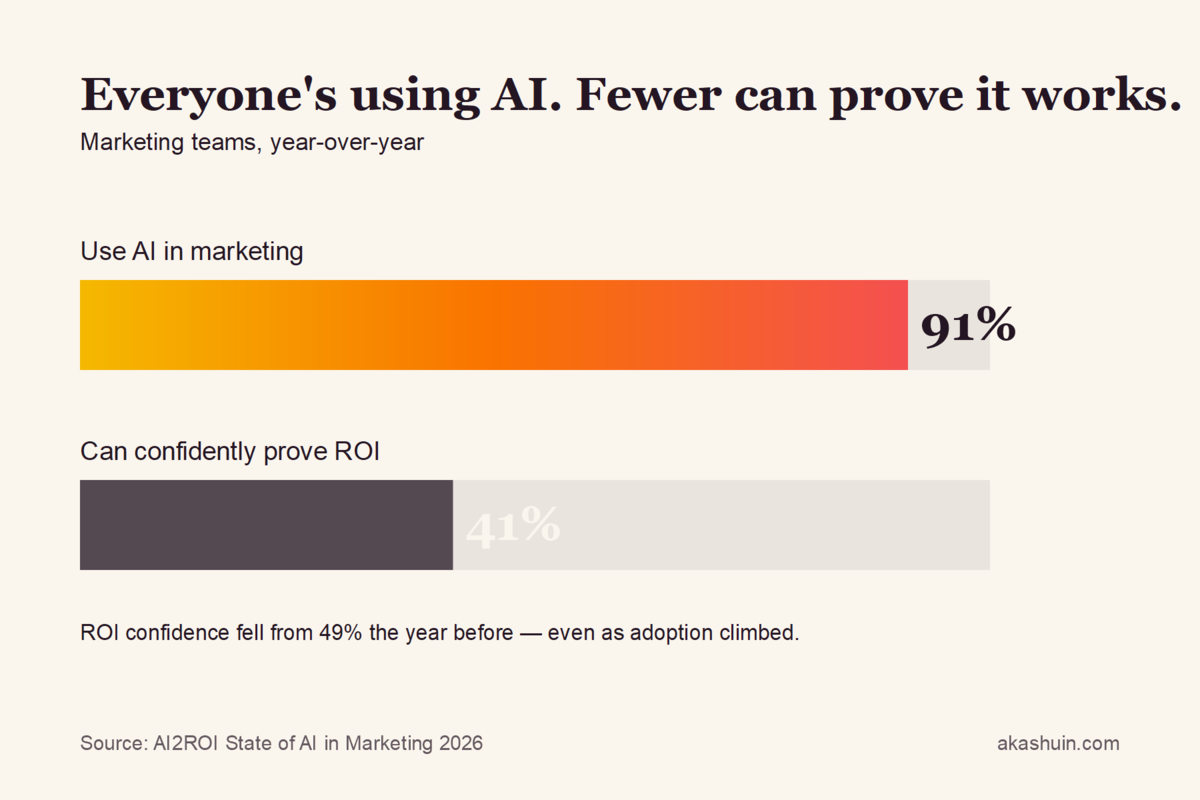
Marketing teams have gone all-in on AI for content. HubSpot’s 2026 State of Marketing report puts AI use at 91% of teams, up from 63% the year before, which is fast adoption for anything in this industry. Idea generation, first drafts, multi-asset campaigns, product copy: all largely AI-assisted now.
Here’s the part that should worry you more than the adoption number. Only 41% of marketers say they can confidently prove that AI is delivering ROI, down from 49% the year before. Adoption went up. Confidence in the results went down. That’s not a rounding error, it’s a trend line pointing the wrong way, and it’s exactly the pattern you’d expect if a lot of teams adopted the tool without adopting the discipline that makes it pay off.
The UK numbers tell the same “everyone’s doing it, few are doing it well” story. The ONS’s June 2026 survey of AI in UK businesses found 35% of businesses with ten or more staff now use at least one AI technology, up from around 12% in late 2023. Within that, 18% are using large language models specifically to generate text, the single most common use case. But adoption is shallow: the average number of AI tools an adopting business actually uses has crept from 1.4 to just 1.6 over the same period. Widespread use. Thin evidence it’s actually working, and barely any sign firms are going deeper once they start.
Why the ROI number is falling, not rising
Two things are happening at once. First, governance hasn’t kept pace with output speed. Concerns about legal, compliance and brand review grew 3.4 times year over year in the same report, the fastest-growing worry in the whole survey. AI can produce a week’s worth of content in an afternoon. Most review processes were built for a much slower publishing cadence, so a lot of that output goes out unchecked simply because nobody had time to look at all of it.
Second, and more basic: a lot of what’s going out is genuinely bad. Not wrong, just forgettable. It reads like the median of everything ever written, smoothed into a paste and published at volume. Readers can feel it even when they can’t say why, and platforms are starting to detect it algorithmically too. Substack’s policy shift is specific about the target: generic listicles, recycled takes, posts with no discernible point of view. Using AI for research or editing is fine. Publishing its unedited median opinion is what gets punished, and that distinction is the one most agencies still haven’t built into their workflow.
Adoption solved the speed problem. It didn’t solve the taste problem, and taste is the part a platform can now detect.
What “doing it well” actually looks like
The firms in that 41% who can prove ROI aren’t using less AI than everyone else. They’re using it with a visible layer of human judgement sitting on top of the output, applied at two specific points: before a draft gets written, and before it goes live. Neither point requires slowing production down much. Both require someone to actually own the decision, rather than letting a tool’s default output become the published version by default.
Ruben Hassid, whose “How to AI” newsletter has become one of the more widely read practical AI guides for non-technical readers, has a method worth stealing for the first point. Before you generate anything, build a running document (he calls it an anti-ai-writing-style file) that lists every word and phrase you’ve come to recognise as an AI tell: “unlock,” “let’s dive in,” the “it’s not X, it’s Y” sentence pattern, overused dashes, whatever your own ear catches. Feed that file into your prompt every time. It’s a five-minute setup that pays off on every piece you generate afterwards, because it forces the model to write in a voice instead of the average voice.
Try this
Two changes you can make this week, no new tools required:
1. Build the ban list. Open a doc, name it whatever you like, and every time an AI draft uses a word or construction that makes it read as machine-written, add it. Paste the list into your system prompt or custom instructions before every generation. It gets more useful every week you keep it, and it’s the single cheapest fix for the “slop” problem, because most AI tells repeat across dozens of pieces once you start noticing them.
2. Add one gate before publish, not before drafting. Governance concerns are spiking because review hasn’t scaled with output, so don’t try to review everything equally hard. Pick the one question that actually catches bad content: “could a named person on our team defend every claim in this piece if a client asked them to?” If the honest answer is no, it doesn’t go out under your brand, however fast it was to produce. Assign that gate to one person by name, not to “the team”, or it quietly stops happening within a month.
The opinion part
AI content tooling is not the differentiator anymore. At 91% adoption it was never going to stay one for long. The differentiator is whether a firm has built the fifteen minutes of human judgement around each piece that keeps it out of the “slop” bucket Substack is now actively burying. That’s a process problem, not a technology problem, and it shows up first in a team’s skills and habits rather than in its toolkit. If you’re not sure whether your team’s AI habits would survive that kind of audit, that’s what an AI skills and adoption review is for: not to add more tools, but to find out where the judgement layer is thin before a platform, or a client, finds it for you.
Leave a Reply