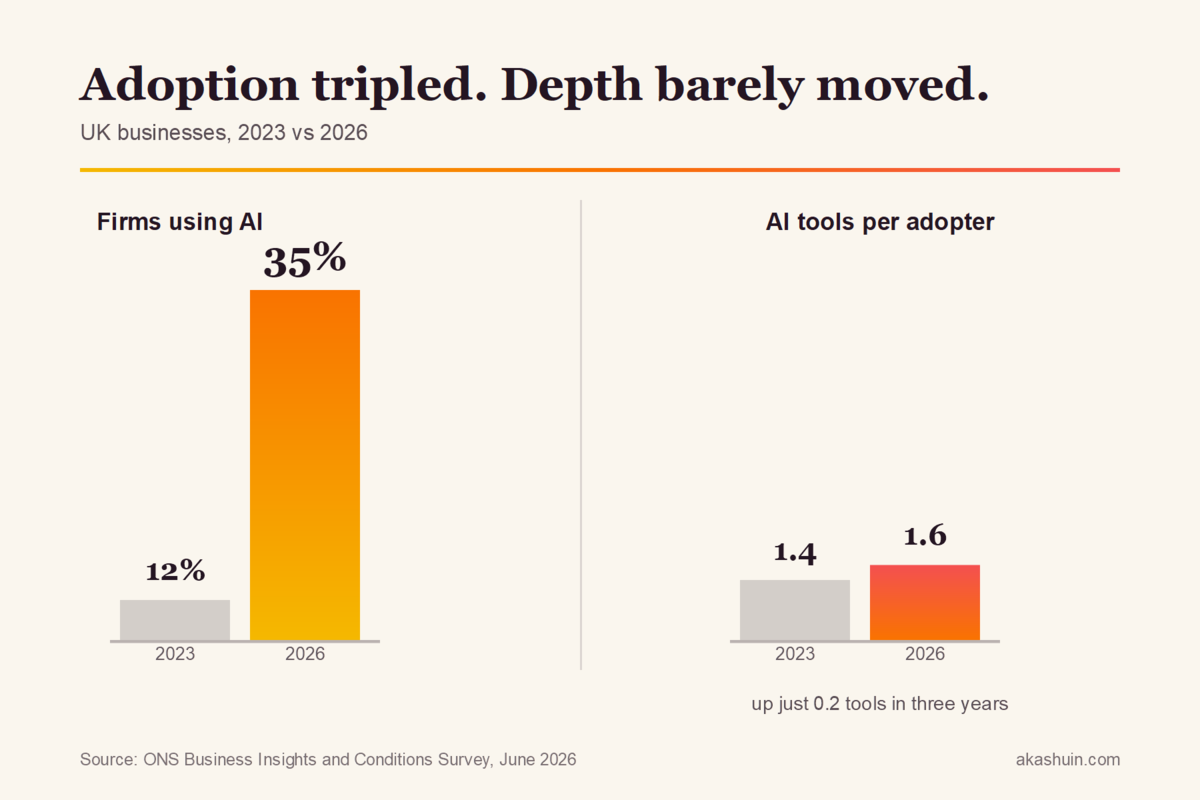
UK businesses now average 1.6 AI tools each, up from 1.4 in 2023. That is the entire depth of three years of “AI transformation” for most firms: half a tool. Adoption tripled over the same period, from 12% to 35% of businesses with ten or more staff, according to the Office for National Statistics‘ Business Insights and Conditions Survey run in June 2026. Everyone signed up. Almost nobody went deep.
I see this constantly with clients. A firm has ChatGPT on three people’s laptops, a Zapier-to-AI thing someone half-built in Q1, and a Notion AI toggle nobody remembers switching on. None of it talks to the others. None of it is anyone’s job to maintain. That’s not an AI strategy, it’s a pile of trial subscriptions, and 1.6 tools per adopter is what that pile looks like from the outside.
The real problem isn’t too few tools. It’s no process for choosing them.
Scott Pope at Nexthink put it well when the ONS numbers came out: adoption is “widening but not deepening”, and the cause is cultural as much as technical. I’d go further: most firms have never actually tested an AI tool against an alternative. They pick whatever a LinkedIn post recommended, run it for a fortnight, and either it sticks by accident or it quietly dies in a browser tab.
Compare that with how a solo operator who actually depends on these tools does it. Angus Sewell wrote up his 2026 stack by running things head-to-head and keeping receipts. He didn’t swap his AI search provider because a blog told him to. He measured it: 87% retrieval accuracy against 73% for the built-in option, with the winner returning actual passages and dates instead of bare links. He dropped n8n entirely, not because automation platforms are bad, but because building a small custom AI skill turned out more adaptable for his actual workload than maintaining a flowchart of triggers. He even reversed a decision on custom frontends after clients told him plainly they preferred an off-the-shelf tool they wouldn’t have to think about.
None of that is exotic. It’s just a testing habit most businesses skip because “trying an AI tool” gets treated as a five-minute favour to do between meetings rather than a decision worth ten minutes of comparison first.
A framework that gets you past 1.6 tools without turning into a tool hoarder
The goal isn’t to use more AI tools. Firms that bolt on six half-used subscriptions aren’t ahead of the 1.6 average, they’re just further into the pile. The goal is to run a real head-to-head before anything earns a permanent seat, and to be willing to cut what loses.
1. Pick one task, not one tool, to start. Don’t ask “should we use Claude or ChatGPT”. Ask “who spends the most repeated hours per week on one narrow task”: drafting first-pass proposals, summarising call notes, chasing invoice status, writing the same three email types. That task is your test bench. A tool that’s brilliant in general but mediocre at your actual bottleneck task isn’t worth adopting yet.
2. Run two candidates on the same ten examples. Take ten real pieces of past work, ten real emails you sent, ten real summaries you wrote, and get two tools to do the same job blind. Score them the boring way: how much did you have to rewrite before it was usable? Sewell’s Exa-versus-built-in-search comparison is the model here: a specific number, on a specific task, not a vibe.
3. Give the winner thirty days with an owner, not a free-for-all. A tool that’s “available to the team” gets used by nobody in particular and dies quietly around month two. Name one person responsible for making it work, including chasing down the annoying edge cases where the output needs a human fix. That’s the difference between the tools that survive Sewell’s stack and the ones that don’t: someone kept forcing them to prove their worth.
4. Cut the loser in writing. If a tool doesn’t win its head-to-head, cancel the trial and say so out loud in the team channel. This is the step firms skip most. Nobody wants to be the person who killed the AI initiative, so half-used tools survive by default rather than by merit, which is exactly how you end up as one of the 35% who “adopted AI” and one of the 1.6-tools-per-firm who never got anything real out of it.
Do this with two tools properly rather than five tools badly, and you’ll be ahead of most of the 35% within a month. Adoption isn’t the scoreboard. A tool that’s actually load-bearing in someone’s daily work is.
Where this tends to go next
Once a firm has one AI tool genuinely embedded in a real workflow, not a demo, a habit, the next bottleneck almost never shows up as “we need another AI tool”. It shows up as “this works but someone still has to copy the output from one system into three others by hand”. That’s a process problem, not a tools problem, and it’s the point where a lot of the firms I work with hit a wall on their own. If that’s where you are, one AI habit that’s working, and a queue of manual steps still wrapped around it, that’s exactly what process automation is built to remove, and it’s worth thirty minutes to map out before you buy tool number three.
Three years from now the ONS will publish another survey. My bet: the adoption percentage will look impressive again, and the average tools-per-adopter number will still be embarrassingly small, because most firms will still be choosing tools by vibe instead of by test. That gap is where the advantage actually sits: not in being first to try something new, but in being the firm that bothered to check whether it worked before keeping it.
Leave a Reply