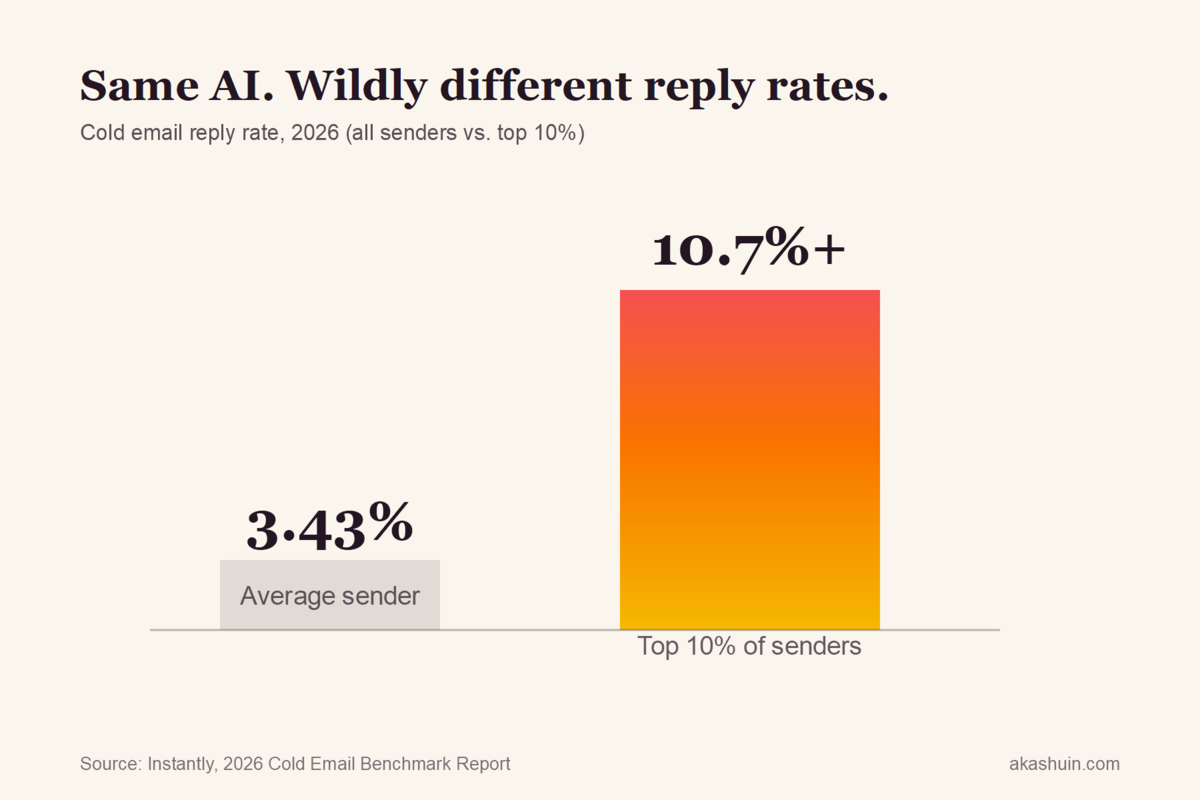
Everyone bolted AI onto their cold email this year. Reply rates, on average, did not move.
Instantly’s 2026 Cold Email Benchmark Report, built from billions of interactions across thousands of active workspaces over 2025, puts the overall average reply rate at 3.43%. That number is barely different from where cold email sat five years ago, before every outbound tool shipped an AI writer. Meanwhile the British Chambers of Commerce’s March 2026 research shows 54% of UK firms now actively using AI, up from 35% in 2025 and 25% in 2024. Adoption tripled in two years. The metric that actually pays the bills stayed flat.
That gap is the real story, and it’s a useful one if you run outreach for an agency or a small service firm. AI didn’t fail at lead generation. Most people used it to do the same thing faster, not to do a different thing.
Where the reply rate actually moved
The BCC data has a second number worth sitting with: of the 54% of firms using AI, only 11% use it extensively to automate or streamline operations. The rest are dabbling: a chatbot here, an AI-drafted email there, without changing the underlying process. Same list, same generic template, same “Hi {firstName}, hope you’re well” opener, just typed by a model instead of a person.
Instantly’s own benchmark shows what the other tier looks like. Their top 10% of senders hit 10.7%+ reply rates, three times the average. What separates them isn’t a better AI model. It’s what the AI is pointed at. The consistent thread across the top performers, and across separate research from Sendr, Unify GTM and Martal’s 2026 cold email data, is signal-based targeting: emailing people because something specific just happened (a hire, a funding round, a tool switch, a website visit) rather than because they match a firmographic filter.
The mechanism is simple. A generic list gets a generic message, and the prospect can tell in one line. A signal-triggered message references something true and current about their business, which is the entire definition of relevance. AI is very good at drafting that message once you hand it the signal. It is not good at inventing the signal for you, and most tools people bought this year only automate the drafting.
Adding AI to a bad list gets you a faster bad list.
The maths behind fewer, sharper emails
Volume was the old lever: send more, book more. Signal-based sending inverts that. A team sending 200 emails triggered by a real signal at a 20% reply rate books roughly the same number of conversations as a team sending 1,000 generic emails at 3%, using a fifth of the volume, a fraction of the domain-warmup risk, and far less time spent by whoever’s writing follow-ups. Fewer, better-targeted emails compound: deliverability holds up longer because you’re not burning domains on blast volume, and every reply is a genuinely interested prospect rather than someone confused about why they got the email.
This is also why “AI for lead gen” as a category gets a mixed reputation. Bought as a volume multiplier, it multiplies whatever was already mediocre about the list and the message. Bought as a targeting and drafting layer on top of real signals, it does what people hoped AI would do for outreach in the first place.
Try this
Two changes you can make this week without buying anything new:
1. Benchmark your own reply rate against 3.43% before you touch AI copy. Pull your last 90 days of outbound. If you’re below 3.43%, the problem is almost never the writing; it’s the list. No amount of AI polish fixes a list built on industry and headcount filters alone. Fix the list first.
2. Pick three trigger events and test a small signal-based batch against your usual send. New hire in a relevant role, a funding announcement, a tool or vendor change you can detect (job posts mentioning a competitor’s product are an easy one). Send 50–100 emails against real signals within 48 hours of the trigger (timeliness matters roughly as much as the signal itself, since relevance decays fast) and run it against your normal batch as a side-by-side. Most firms that do this find the signal batch outperforms 3–5x, which matches what the wider research above shows. You don’t need a fancy intent-data platform to start: a saved LinkedIn search and a Google Alert cover the first three signals for free.
Once that’s proven at small scale, the actual bottleneck becomes catching the signals reliably and getting the drafted email into a rep’s outbox within the 48-hour window — which is a process problem, not a copywriting one. That’s the part worth automating properly rather than doing by hand every morning: it’s exactly the kind of repetitive, time-sensitive workflow we build for clients at Ishigai’s process automation service — watching for the signal, drafting against it, and queuing it for a human to approve, so nothing sits stale past the window that actually matters.
The opinion part
The 3.43% average isn’t a ceiling on what AI can do for outreach. It’s a snapshot of what happens when a fast tool gets pointed at a slow, generic process and everyone assumes the tool did the work. It didn’t. The list, the signal and the timing did the work; the AI just typed it up quicker. Firms chasing the 10.7% tier aren’t using smarter AI. They’re using AI on a sharper input. Fix what goes in before you worry about what writes it.
Leave a Reply