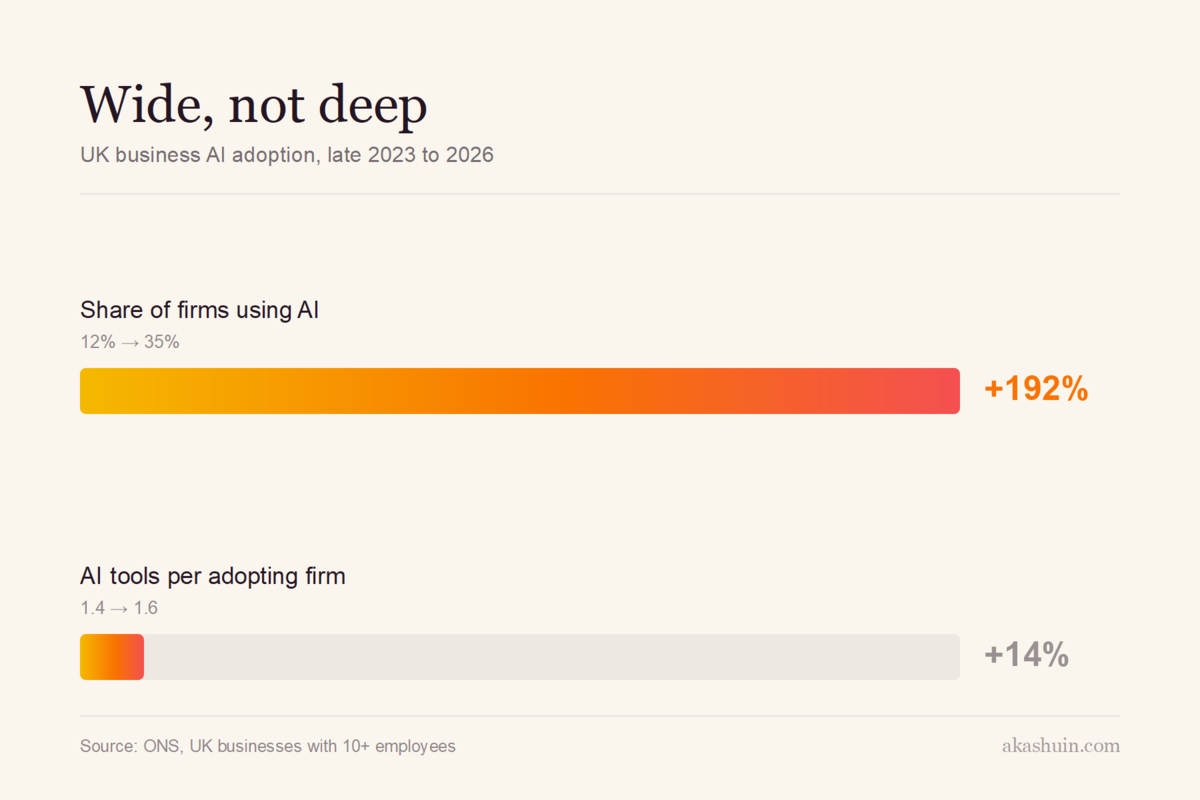
The Office for National Statistics published figures this month that should give pause to anyone selling AI to British businesses, and anyone buying it. AI use among UK firms with ten or more employees has roughly tripled since late 2023, climbing from about 12% to 35%. On the face of it, that reads like a technology winning.
Then you look at the depth. The average number of AI tools per adopting firm moved from 1.4 to 1.6. Only 10% of adopters call their own usage “extensive”. Just 15% say more than half their staff use AI daily. And only 11% report that more than half their workforce has had any AI training at all.
Three years of enthusiasm. Two-tenths of a tool.
Adoption is not the same as change
The gap gets wider the closer you look. The British Chambers of Commerce, working with Atos, put UK SME AI adoption at 54%. The government’s own DSIT adoption research finds roughly 16% of firms have made a strategic AI deployment. Both numbers can be true, because they are measuring different things. One counts firms where somebody, somewhere, has opened ChatGPT. The other counts firms that have actually rebuilt a process around it.
The ONS data makes the same point in a different way. Nearly 60% of adopting firms use AI to make existing operations more efficient. Fewer than one in five use it to build new products, reach new markets, or do something they could not do before. Around half report no change in headcount, which is a polite way of saying nothing structural happened.
Most firms have bought a subscription. Very few have changed a workflow.
I see this constantly. A recruitment agency tells me they are “using AI” and what they mean is two consultants paste job descriptions into a chatbot and tidy the output. That is not nothing. It saves them twenty minutes a day each. But it is not the thing that changes the shape of the business, and it will not survive either of them leaving.
The barrier is not what people assume
Here is the finding I keep coming back to. When the ONS asked firms what was holding them back, 41% said nothing at all. No regulatory problem, no budget problem, no skills crisis. Nothing.
Among firms that did name a barrier, the top answer was lack of expertise, cited by up to 18% of businesses with 100 to 249 staff.
Put those together and you get an uncomfortable picture. A large share of British firms are not blocked. They simply do not know what to do next. They have the budget, the permission and the appetite, and they are stuck at the point of asking which problem is worth solving. That is a very different constraint from the one most AI vendors are selling against.
It also explains the tool count. If you do not know where the value is, buying one more tool feels like progress. It is measurable, it is quick, and it produces something you can mention in a board meeting. Redesigning how quotes get produced does not.
What the productivity numbers actually promise
The upside is real, which is what makes the shallowness frustrating. Public First’s analysis for Google estimates AI tools could lift UK SME productivity by around 20%, roughly an extra working day a week, worth up to £198 billion across the economy. A 2025 government study found 56% of businesses using AI reported higher employee productivity.
Notice the framing though. An extra day a week is not what you get from a chatbot subscription. It is what you get when a process that took four hours takes forty minutes, permanently, whether or not the person who set it up is in the office.
Try this: the two-week audit you can run yourself
You do not need a consultant to find your first real candidate. You need a week of honest observation and a spreadsheet. Here is the version I use before quoting anyone.
1. Log the repeats, not the annoyances. For five working days, have your team note any task they did more than three times that week that followed roughly the same steps each time. Not what irritated them, what repeated. The two lists overlap less than you would think, and the repeats are where automation pays.
2. Score each one on three columns. Hours per month. How much judgement it needs, high, medium or low. And whether the inputs live somewhere a computer can reach, an inbox or a CRM counts, someone’s memory does not. Anything with high hours, low judgement and reachable inputs is your shortlist. That is usually three or four things, and they are rarely the ones people guessed.
3. Kill your favourite idea first. Whatever you were excited about before you started, check it against the three columns. If it needs high judgement or the data lives in someone’s head, it is a bad first project regardless of how good it sounds. Starting with the hard one is the most common way these efforts die.
Do that honestly and you will end up with a ranked list of two or three processes with hours attached. That list is worth more than most AI strategy documents, because it is about your business rather than the category. If you would rather not run it yourself, that is more or less what an AI opportunity audit produces, but the method is not a secret and you are welcome to it.
The uncomfortable conclusion
The ONS numbers will be read two ways over the next few months. Vendors will use the 35% to argue that everyone is doing this and you are behind. Sceptics will use the 1.6 tools and the flat headcount to argue it is all hype.
Both readings miss it. The interesting group is the 41% who report no barriers at all and still have not moved. They are not waiting for the technology to improve or the regulation to settle. They are waiting for someone to tell them which of their problems is worth pointing this at.
My honest opinion, having built these systems for agencies and service firms: the firms that pull ahead over the next two years will not be the ones with the most AI tools. They will be the ones who picked two processes, rebuilt them properly, and left the rest alone. Breadth is what the statistics measure. Depth is what pays.
Leave a Reply